
There are some types of data you simply do not want stored in someone else’s cloud. Audio recordings of interviews, for instance, may contain sensitive information – such as those produced by the Institute of Political Science at the University of Innsbruck. As these conversations are set to be transcribed using AI in future, the team looked for a way to handle this task locally. They found Andreas Lindner from the Austrian National Competence Centre for Supercomputing, who developed an AI-based tool within the EuroCC project. The solution runs on Innsbruck’s high-performance computing (HPC) system LEO5 and ensures full data sovereignty for the institute.
Bettina Benesch
In political science, interviews are often the method of choice for collecting research data. However, manually transcribing recordings is both time-consuming and costly. As a result, many researchers now rely on AI-based transcription tools. “Automatically generated transcripts are everywhere these days – even if the quality is not always convincing,” says Professor Franz Eder, political scientist at the University of Innsbruck (UIBK). “That made me wonder: can we do better – and, above all, can we run it locally on our own servers so that the data stays in-house?”
To answer this question, Andreas Lindner joined the project. He specialises in deploying AI models efficiently on HPC systems. The project also received support from the HPC team of the Central IT Services (ZID) and the university’s research focus area Scientific Computing.
“
Automatically generated transcripts are everywhere these days – even if the quality is not always convincing. That made me wonder: can we do better and can we run it locally so that the data stays in-house?
„
The solution needed to be powerful enough to run modern AI models, operate entirely on local infrastructure, and give the university full control over processes and data. These core requirements were quickly met. However, as discussions with users progressed, expectations grew step by step: speakers had to be identifiable, timestamps inserted, and translations into other languages enabled. What began as a small assignment evolved into a sophisticated project combining advanced features, computational efficiency and digital sovereignty.
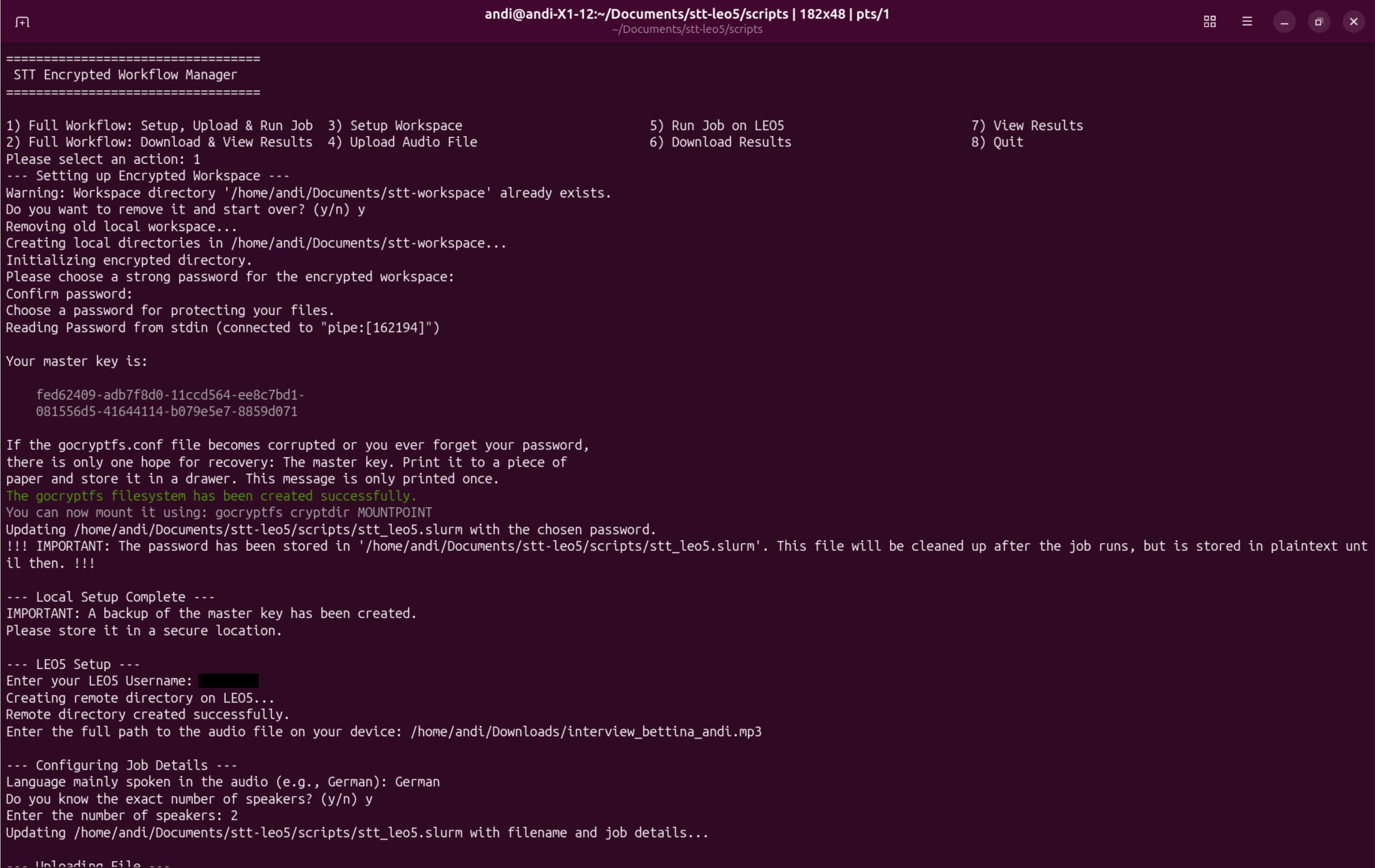
Today, the tool follows a clearly defined workflow spanning a Linux workstation and the local HPC system LEO5. After an audio file is transferred from a workstation at the Office for Open Science within the Faculty of Social and Political Sciences to the university’s supercomputer, the audio is analysed and segmented by speaker. The tool then automatically transcribes each segment. If required, the completed transcript can subsequently be translated into other languages.
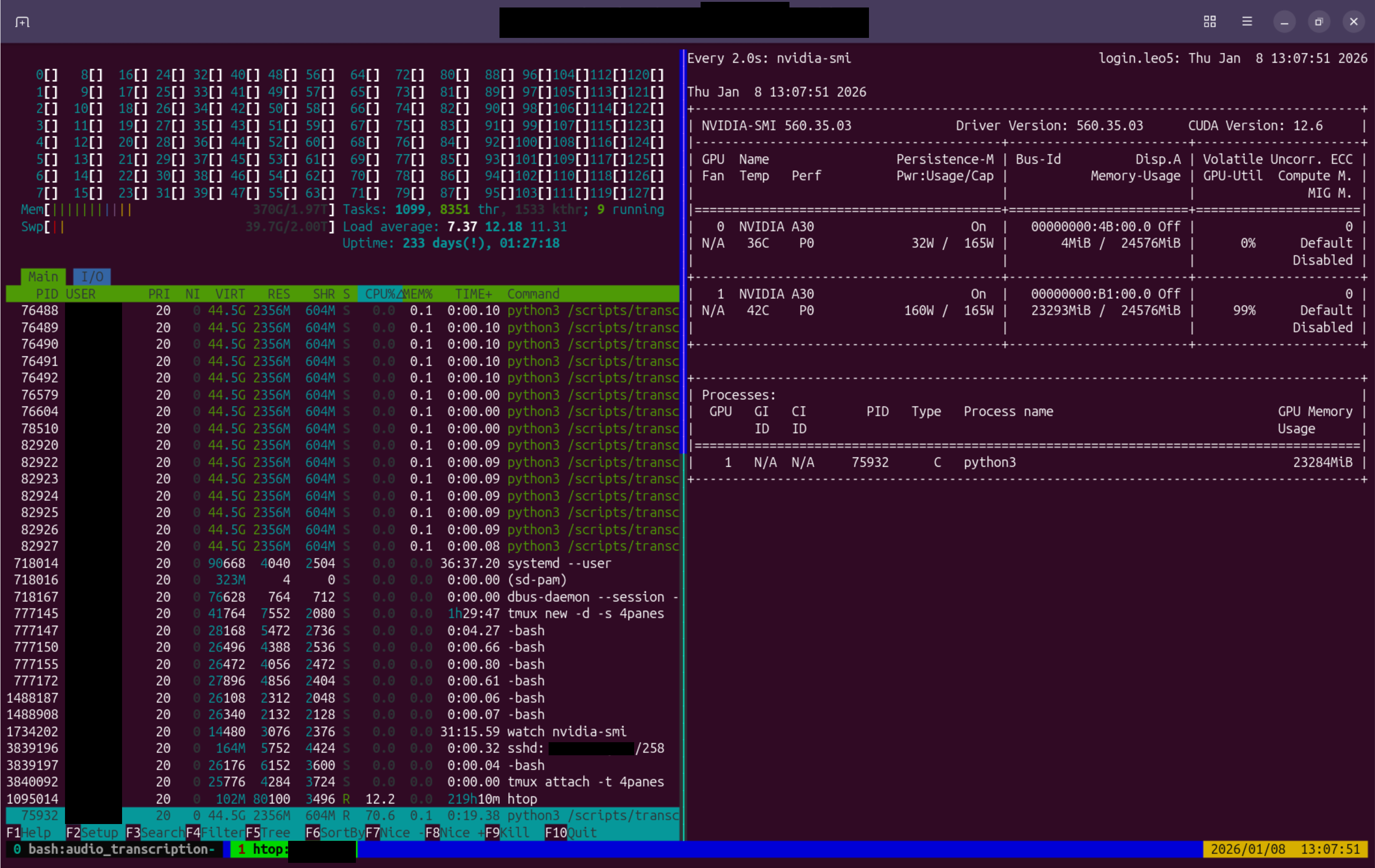
The AI solution deliberately builds on established, well-documented components, which Andreas Lindner specifically adapted for use on LEO5:
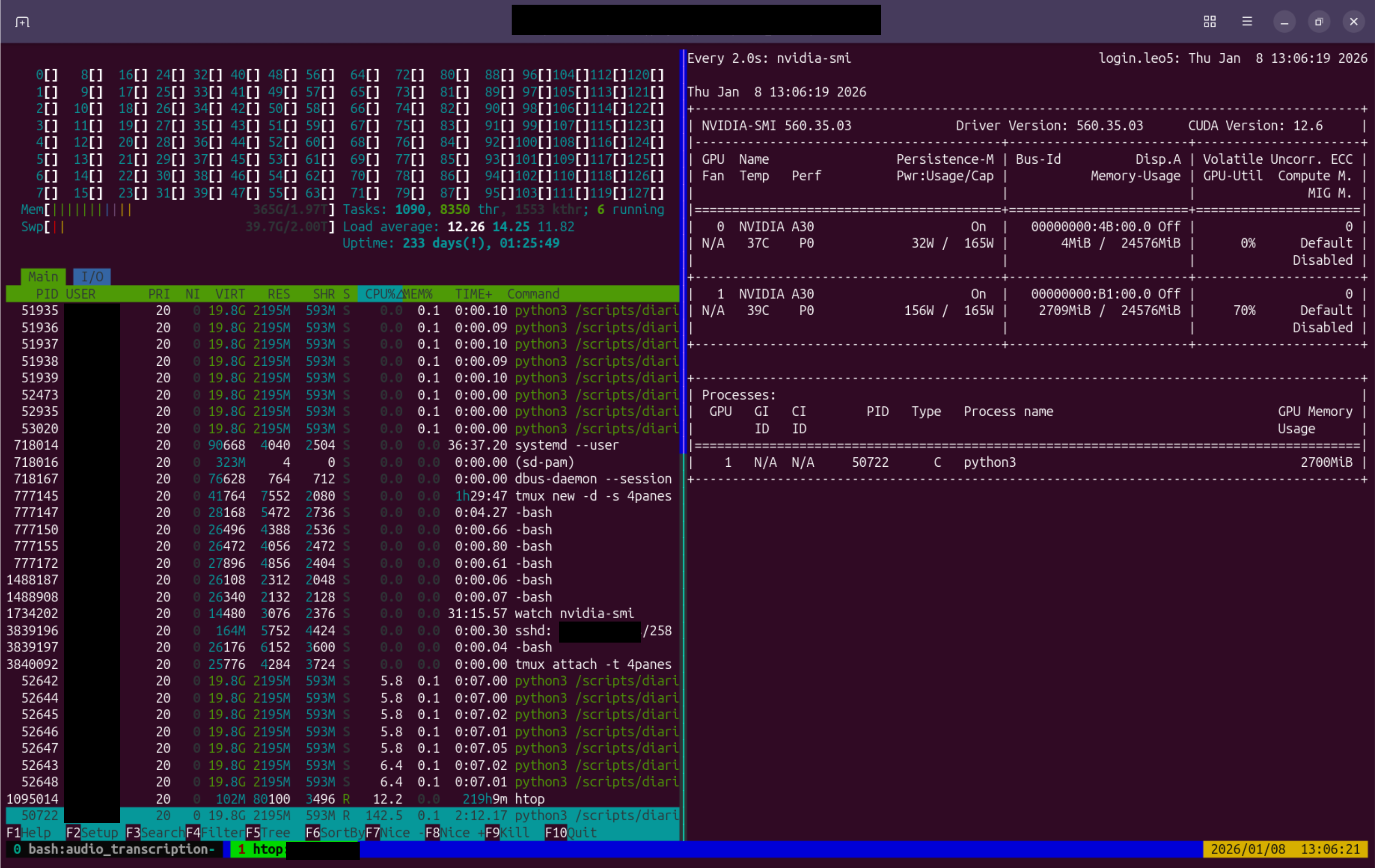
The solution is now technically operational and fully documented. It integrates into the existing research infrastructure, relieves researchers of the time-intensive transcription process, and safeguards data sovereignty. AI Factory Austria (AI:AT) uses the tool internally to transcribe video conferences. Incidentally, the interview with Andreas Lindner on which this article is based was itself transcribed using the new tool on LEO5.
An additional benefit of the system is that transcription tasks are not time-critical. They are automatically scheduled into computational gaps between other projects. This improves utilisation of the HPC systems, which consume power even when idle. By putting otherwise unused capacity to productive use, overall energy efficiency increases.
With this new tool, the Faculty of Social and Political Sciences now has access to an AI-supported solution that simplifies research workflows, preserves data sovereignty, and demonstrates how modern technology can be deployed responsibly.
Since automated transcription is needed not only in Innsbruck but in many other institutions, Andreas Lindner has made the corresponding GitLab repository publicly available. It may therefore also be useful for other operators of high-performance computing clusters who wish to implement a similar setup:
https://researchdata.uibk.ac.at/records/z877w-c6110
https://doi.org/10.24433/CO.0416787.v1
Dr Andreas Lindner earned his PhD in computational physics at LMU Munich, where he conducted simulations of quantum phenomena on HPC systems. In 2024, he joined the Austrian Competence Centre for Supercomputing (EuroCC Austria) as an HPC and AI expert, and has served as Project Lead since April 2026.