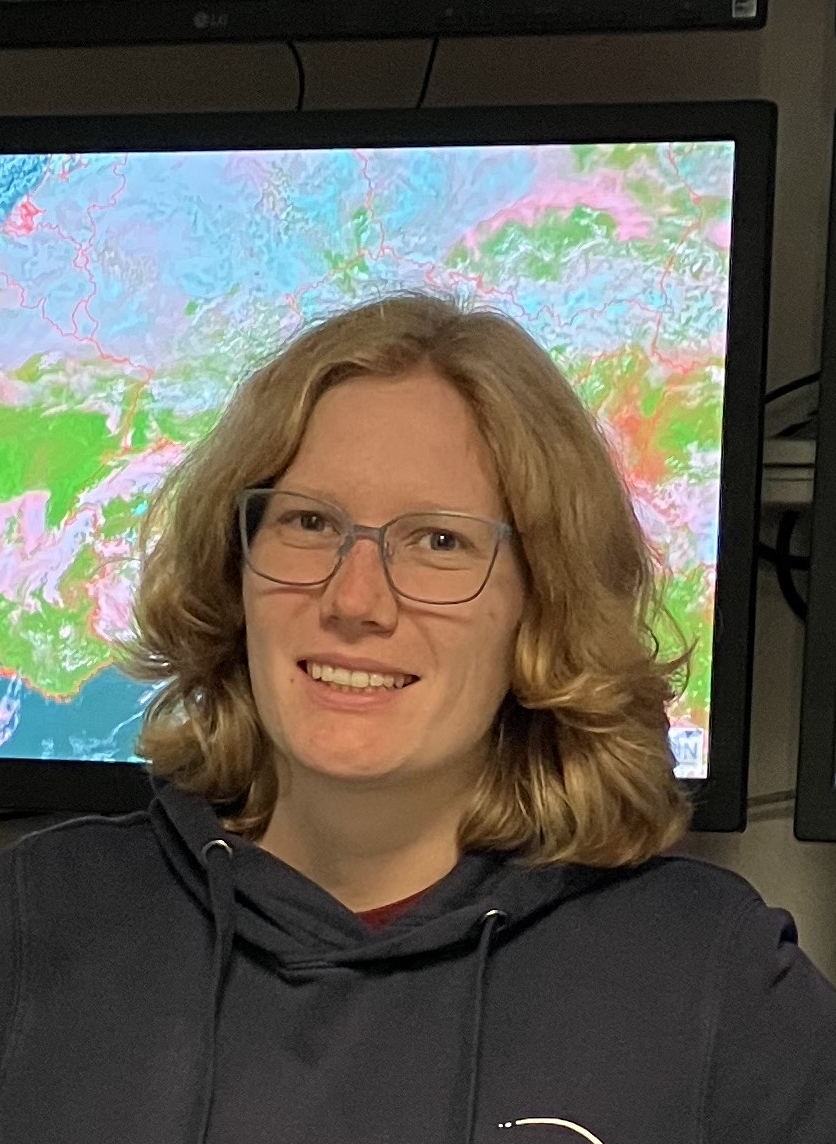
We know flying carpets from fairy tales – but flying deserts are real: thick layers of hot desert air that travel all the way to Europe. Once there, they settle like a lid over the atmosphere and influence our weather. Atmospheric scientist Fiona Fix-Hewitt is researching this little-known phenomenon using supercomputing and millions of virtual balloons. In this interview, she talks about the dynamics of the atmosphere and life with HPC systems.
Bettina Benesch
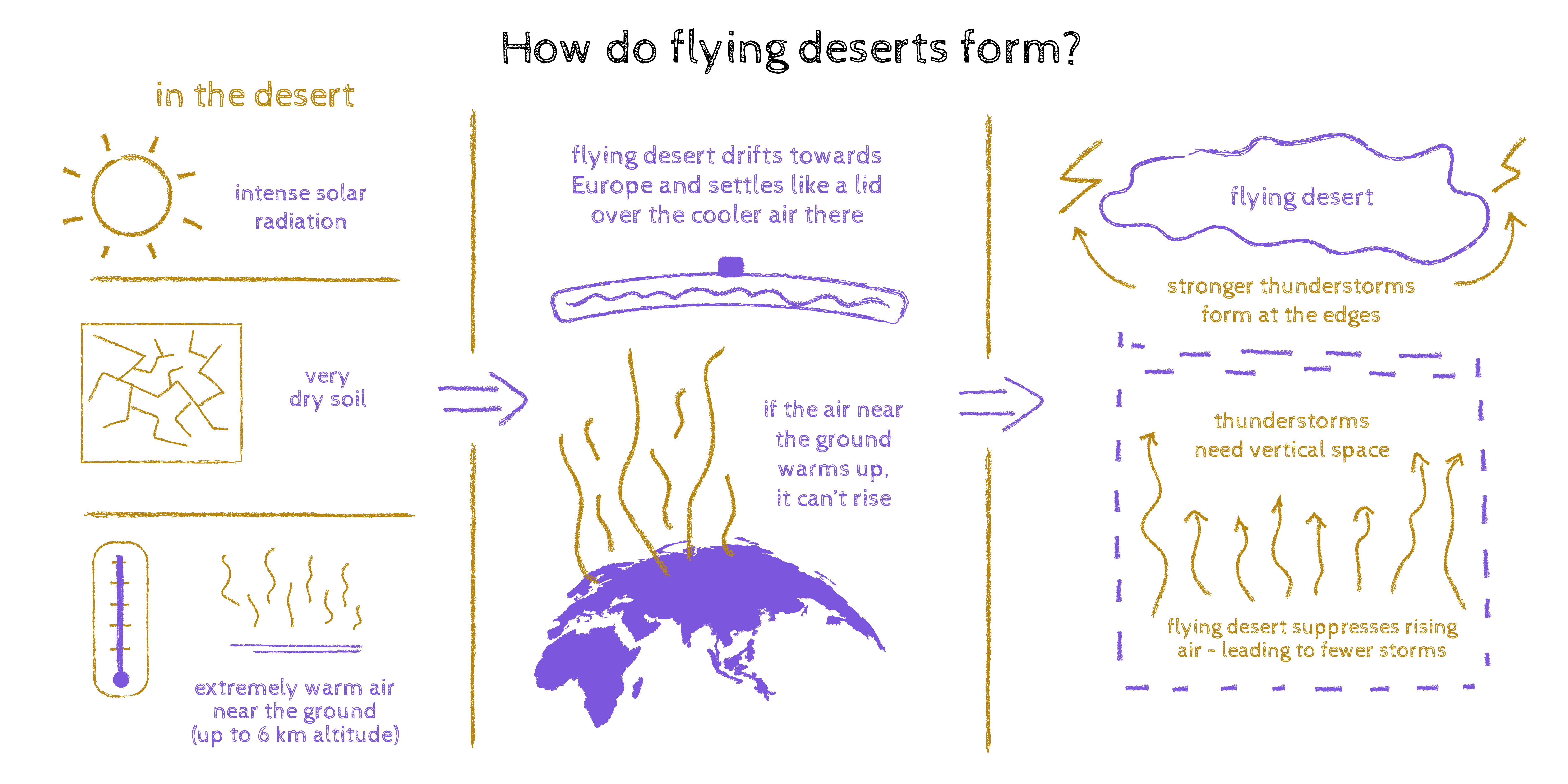
Fiona Fix-Hewitt: They are air masses that form near the ground in hot, dry regions. We also call them atmospheric deserts. Here in Europe, some of the soil moisture has to evaporate first, and only then can the remaining energy be used to heat the air. But in desert regions, because it’s so dry, the energy can be directly converted into what we call sensible heat. That’s why the layer of air close to the ground is extremely warm and dry. Temperatures can reach up to 40 degrees Celsius. We refer to this layer as the boundary layer or atmospheric boundary layer. In deserts, this layer can grow up to six kilometres high, whereas in Europe it typically reaches only one to two kilometres.
Due to the interaction between the high and low pressure systems, the warm, dry air that forms near the ground in North Africa, for example, is transported towards Europe. Since it’s warmer and drier than the air near the ground here, it flows over the top. Hence, you have our normal boundary layer, and above that, this flying desert.

Fiona Fix-Hewitt: Starting just above the boundary layer, which is around two kilometres high. The entire warm air mass can extend upwards to about twelve kilometres.
Fiona Fix-Hewitt: They can cover the whole of Europe. I currently observe flying deserts coming from Africa over a period of five days, and during that time, they can reach as far as Norway.
Fiona Fix-Hewitt: Because I assume that after five days, the air mass has changed so much that it’s no longer desert-like and therefore no longer relevant for our analysis.
“
The flying desert acts like a lid. This can trap warm air beneath it and suppress thunderstorms. Elsewhere, though, storms may become more intense.
„
Fiona Fix-Hewitt: Because desert air is extremely dry and warm, the layers remain separate: warm air wants to rise, and the cooler, more humid air stays below. Of course, there is always a bit of mixing at the boundary due to turbulence – and also if our boundary layer is already quite warm and the desert air has cooled slightly on its journey. The closer the properties of the two layers are, the more likely they are to mix. But as long as they are different, they remain separate.
Fiona Fix-Hewitt: The flying desert acts like a lid, and this can have various effects: warm air can get trapped beneath the lid, causing ground-level temperatures to rise more than they would otherwise. The lid is also relevant for thunderstorm development. You can think of it like a lava lamp, where air bubbles rise to the top. Thunderstorms need to rise high enough to actually produce lightning and not just form clouds.
But when this warm lid is present, air can’t rise as easily. This means thunderstorms are suppressed. However, at the edges of flying deserts, the air can rise – and that’s where thunderstorms tend to form, sometimes even more frequently and more intensely. Our project “Atmospheric Deserts” aims to understand exactly how all this fits together and what the concrete effects are.
Fiona Fix-Hewitt: It’s about understanding how extreme weather – including thunderstorms – develops, so we can improve forecasts. For example, if we know that thunderstorm probability is higher at the edges of flying deserts, that could be valuable information for weather prediction.
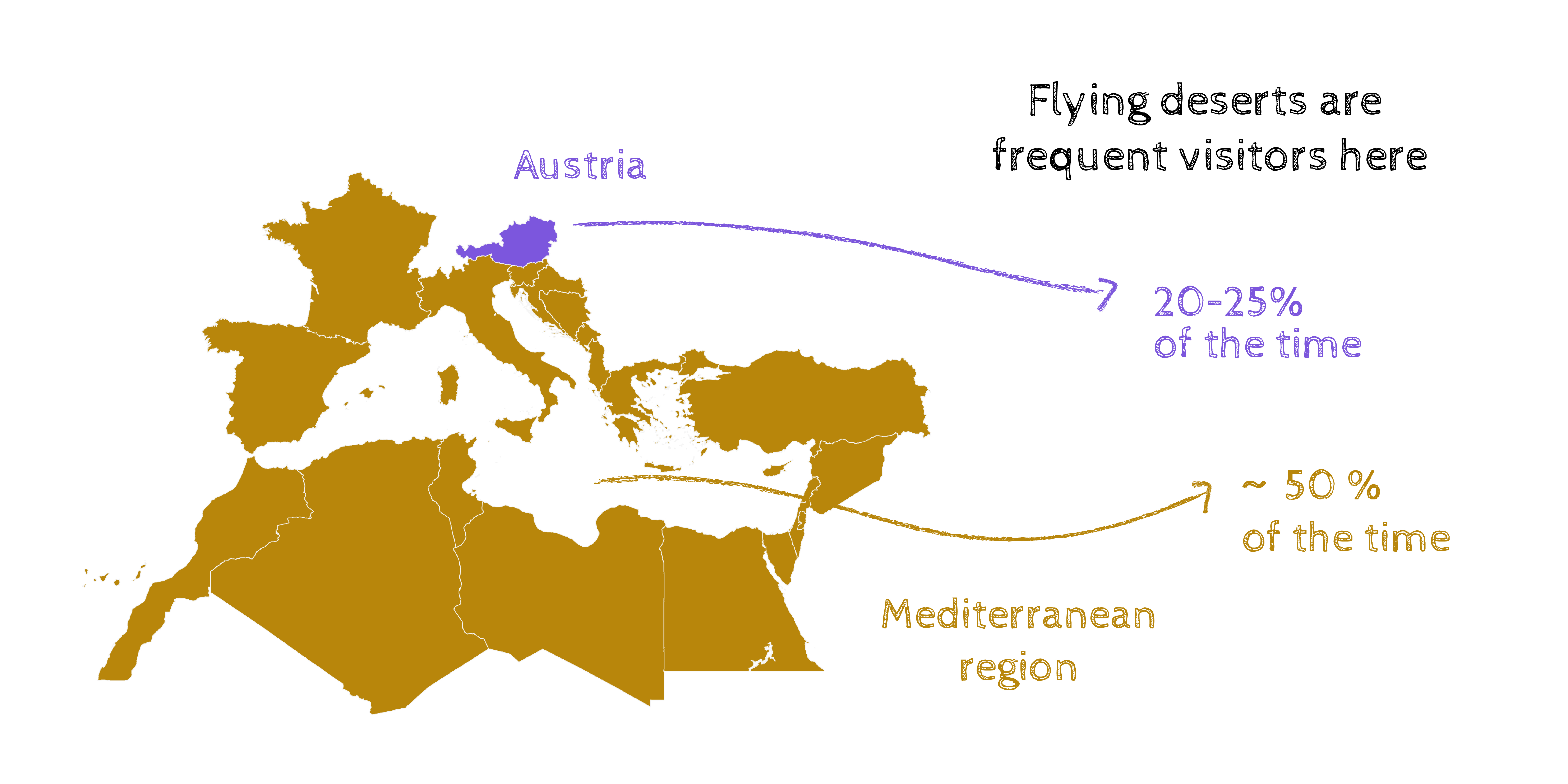
Fiona Fix-Hewitt: Flying deserts typically prevail over Europe for one to five days, depending on the location: they don’t last as long in Norway as in the Mediterranean, simply because it takes longer for the air to get there from Africa. In the Mediterranean region, flying deserts are present almost half the time. In Austria, we have Saharan air over us 20 to 25 percent of the time.
One thing our research didn’t show – contrary to our original assumption – is a significant impact of flying deserts on the temperature of the boundary layer in Europe. But even that’s a valuable result.
Fiona Fix-Hewitt: My current focus is on flying deserts in Europe. However, they occur wherever there are hot and dry source regions – and such regions are common across the globe. Around 30 percent of the planet is desert.
We see our research in connection with other phenomena that have already been studied more extensively. Ideally, the concept of flying deserts could help unify these separate phenomena. Right now, various weather events are considered individually, even though they may be linked. If we can develop a broader concept, it could be very valuable for weather forecasting.
“
Currently, different weather phenomena are considered separately, even though they are likely connected. If we can develop an overarching concept, it could prove highly valuable for weather forecasting.
„
Fiona Fix-Hewitt: I can’t say much about climate yet, because my dataset only covers two years. But when I think about flying deserts in the context of climate change, two aspects come to mind:
First: we know that more and more regions are undergoing desertification. The Sahara, for example, is expanding, and other areas are also becoming drier. That means there are potentially more source regions, and therefore more frequent and more widespread flying deserts.
Second: climate change is altering large-scale weather patterns, such as the jet stream and the position of high and low pressure systems. This could mean flying deserts occur more often and last longer – or, possibly, become less frequent.
Fiona Fix-Hewitt: Our project is the first to study flying deserts in this form – as an overarching phenomenon that encompasses various other weather events. The project team includes my supervisor Prof. Georg Mayr, our master's student Jana Schitthof, myself, and collaborators from the Statistics Department.
There has been research into so-called elevated mixed layers – a detached, well-mixed air layer. That’s essentially a subgroup of flying deserts. Elevated mixed layers have been studied to some extent, especially in the US, and to a lesser degree in Europe, and that’s the foundation we’re building on – but we believe the phenomenon is broader than what’s been examined so far.
So the term “flying deserts” is a generalisation, an extension of the concept of elevated mixed layers. We want to understand how Saharan air changes along its path to Europe, how it affects thunderstorm formation and temperature here – and what elements can be transferred from the elevated mixed layers concept and what needs to be considered differently.
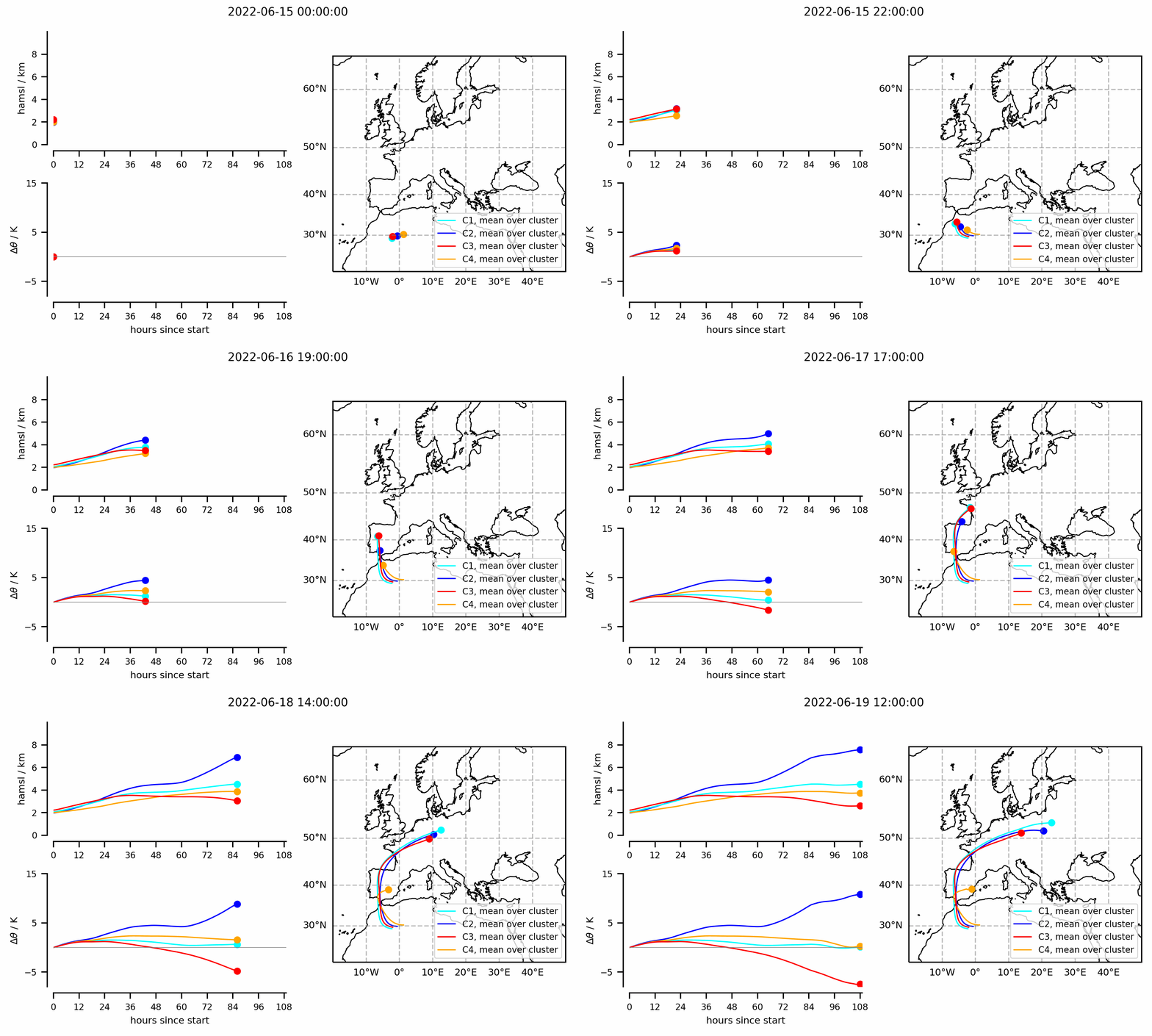
Fiona Fix-Hewitt: I use what are called trajectories. A trajectory is the path something follows over time – in my case, the route the air mass takes on its way to Europe. You can imagine the individual trajectories like thousands of balloons released from the Sahara. Each balloon represents a parcel of air, and its path is a trajectory. Together, they make up the air mass. I use a special trajectory model called LAGRANTO – the Lagrangian Trajectory Analysis Tool. It needs input data like wind, temperature and pressure to calculate the paths.
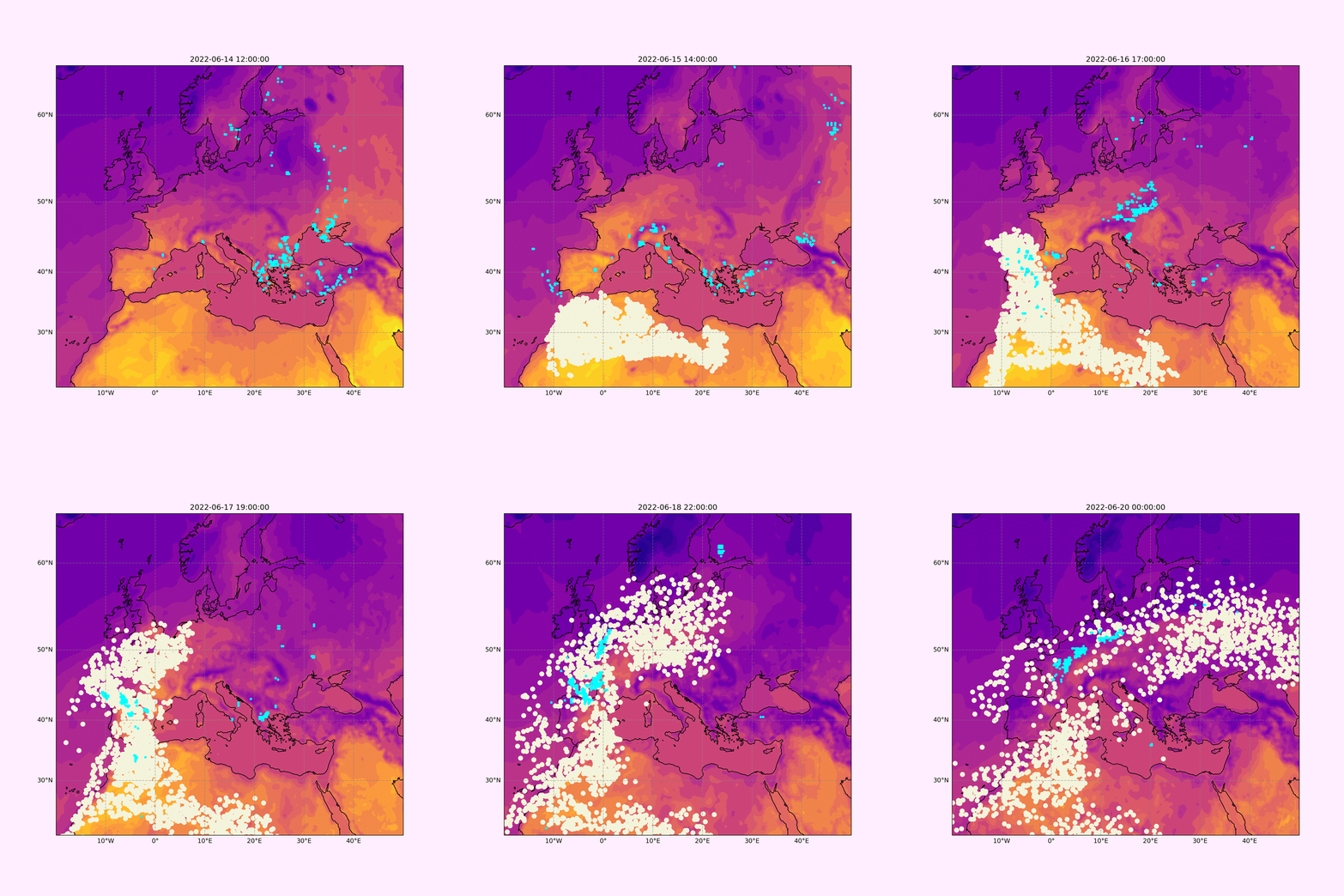
Fiona Fix-Hewitt: HPC has been part of my work for quite a while – more or less out of necessity. Not in my master’s thesis, but already in my bachelor’s. In our field, we work with large datasets, so HPC is essential. I learned most of it through trial and error – learning by doing. I also took part in a workshop at the ASC.
Fiona Fix-Hewitt: The ASC system in Vienna.
Fiona Fix-Hewitt: Huge datasets. Parallelisation. And debugging. Lots of debugging.
Fiona Fix-Hewitt: Sometimes the issues are cluster-related. In those cases, there’s not much I can do – I just need to recognise them for what they are. Just this morning, for instance, the supercomputer was down and I couldn’t log in. Sometimes a job crashes and you don’t really know why. Other times, the problem lies within the code – usually something you caused yourself.
Fiona Fix-Hewitt: You could say I use AI in the broadest sense: I use statistical methods, including machine learning, which can be considered part of AI. But I wouldn’t say I’m using the AI that everyone’s currently talking about. AI is much more than ChatGPT – it also includes these types of statistical models.
“
Three words to describe HPC? Massive datasets. Parallelisation. And debugging. Lots and lots of debugging.
„
Fiona Fix-Hewitt studied meteorology at the University of Hamburg, completing both her bachelor’s and master’s degrees with top honours. She has received several awards, including recognition from the German Meteorological Society, and held a scholarship from the German National Academic Foundation. She is an atmospheric scientist and, since May 2023, a PhD candidate at the Department of Atmospheric and Cryospheric Sciences (ACINN) at the University of Innsbruck.
As part of her PhD project Atmospheric Deserts, she investigates so-called flying deserts – very hot, dry air masses from desert regions. Her research focuses on how flying deserts form, how they change on their way to Europe, and what influence they have on heat and thunderstorm events in Europe.